

48 hours only! Get 20% off progressive lenses | Use code: GET20


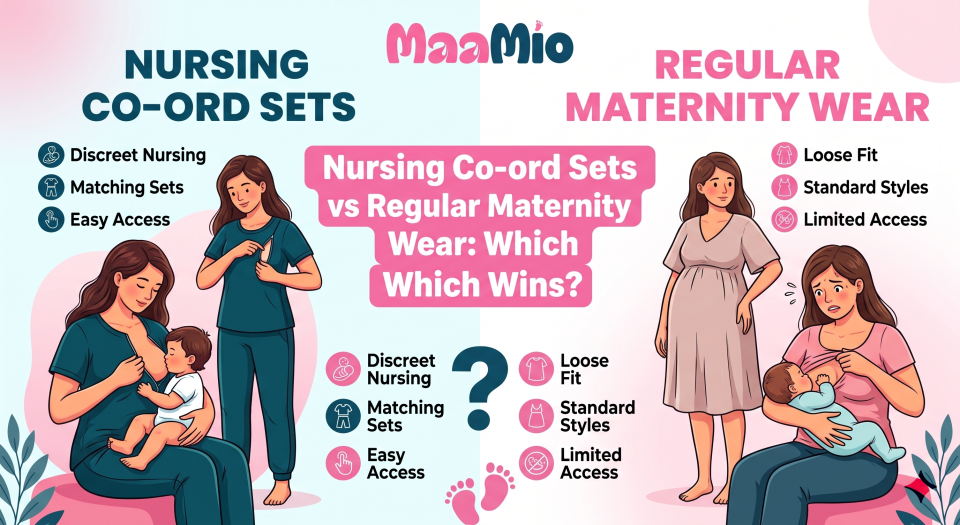
Nursing co-ord sets vs regular maternity wear: which wins?
October 03, 2026
Picture this: you are three weeks postpartum, a visiting relative is at the door, the baby needs feeding, and every single top in your wardrobe requires you to lift it completely above your chest. The maternity dress you wore throughout your third trimester? Hangs awkwardly now that the bump is gone. The stretchy kurta you loved at week 36? Zero nursing access. This maternity fashion comparison exists to help you avoid exactly that trap, because many Bangladeshi mothers find themselves spending on pregnancy clothes that become redundant almost the moment the baby arrives.
The question is not whether nursing co-ord sets or regular maternity wear look better. The question is which one actually earns its place in your wardrobe across the full arc of pregnancy and breastfeeding. At MaaMio, we work closely with mothers across Bangladesh, and what we observe consistently, through customer feedback and real usage patterns, is that the wrong wardrobe choice costs more in the long run, both financially and in daily frustration.
By the end of this article, you will have a clear framework for deciding where to spend your maternity clothing budget, a trimester-wise view of what actually performs, and a straightforward answer to the co-ord set vs regular maternity wear debate.
What actually separates nursing co-ord sets from regular maternity wear
Before comparing performance, it helps to understand exactly what you are comparing. These are not just two versions of the same thing at different price points. They are engineered for different phases of a mother's life, and that difference shows up in every seam, panel, and closure.
How the fit is engineered differently
Regular maternity wear is sized for a growing bump. The waistbands are elasticated, the ruching accommodates expansion, and over-belly or under-belly panels are positioned to support the abdomen during pregnancy. That engineering stops there. Once the bump is gone, the under-belly panel hangs loose, the structured belly band serves no purpose, and the top that draped beautifully over a third-trimester belly reads as shapeless on a postpartum body, a frustration commonly cited in customer fit feedback.
Nursing co-ord sets are designed to accommodate both stages. The tops use wrap configurations, crossover necklines, or discreet panel openings that work with a pregnant body and transition seamlessly after delivery. The bottoms pair high-waisted elasticated waistbands with enough stretch to adapt whether you are 34 weeks pregnant or 10 weeks postpartum. The fit logic is built for a moving target, not a fixed one. For practical guidance on adjusting garments as your body changes, see how maternity clothes should fit even when your body keeps changing.
The fabric factor: stretch, breathability, and skin sensitivity
In Bangladesh's climate, breathability is non-negotiable. Wearing a synthetic-blend maternity top through a humid Dhaka afternoon, or during a monsoon-season hospital visit, is genuinely uncomfortable. Based on garment performance across Bangladesh's warm, humid conditions, cotton, bamboo, and micromodal consistently prove the most suitable fabrics for maternity and nursing wear. Cotton absorbs moisture without trapping sweat. Bamboo fabric adds natural thermoregulation and antimicrobial properties, which matters when skin sensitivity is heightened during pregnancy.
Regular maternity wear from general retailers often uses polyester blends to keep costs down. These fabrics stretch adequately but trap heat and can irritate sensitive postpartum skin. Nursing co-ord sets built for the Bangladeshi market, including MaaMio's range, prioritise cotton and bamboo blends precisely because daily wearability in this climate depends on fabric choice. If you want to explore what sustainable maternity clothing looks like in practice, the fabric composition is always the first place to look. For a helpful overview of ethical maternity clothing, start here.
Built-in nursing access: a feature, not a bonus
This is the design feature that determines whether a garment survives delivery day. Nursing co-ord set tops typically include hidden zip panels under the shoulder, crossover wrap fronts, or button plackets that allow discreet breastfeeding access without lifting, removing, or restructuring the top. Regular maternity tops have none of this. To nurse in a regular maternity top, you lift it completely or layer underneath it, neither of which is practical at 2am, or when a relative has just walked through your door.
Comfort across trimesters: a maternity fashion comparison
A sound pregnancy wardrobe guide does not treat all three trimesters as identical. The comfort demands shift significantly from the first trimester to the third, and so does the case for each clothing type.
First and second trimester: when regular maternity wear holds its own
In the first trimester, the bump is small and the body changes are subtle. This is the phase where budget-conscious mothers can legitimately mix regular maternity pieces with existing wardrobe items. Stretchy wrap dresses, oversized kurtis, and pull-on trousers from your existing wardrobe often work through week 16 without any dedicated maternity purchase. When you do start buying, a few solid maternity basics, a couple of elasticated-waist bottoms and two or three longer tops, cover most needs until the second trimester progresses.
The maternity capsule wardrobe logic here is straightforward: do not over-invest early. The body changes most significantly in the third trimester, and what fits well at week 14 may not reflect what you need at week 32. Keeping first and second trimester purchases minimal and affordable is sensible strategy.
Third trimester and beyond: where support and adaptability matter most
By week 28, comfort demands intensify considerably. Belly weight increases, skin sensitivity heightens, and Bangladesh's heat makes breathability even more critical. This is the phase where the loose, adjustable construction of a nursing co-ord set genuinely outperforms structured regular maternity garments. A co-ord set purchased at week 28 starts earning its value immediately: it accommodates the growing belly, works in the heat, and remains in active daily use well into the breastfeeding period after delivery, though actual duration will vary depending on how frequently you wear and launder it, and how long you breastfeed.
This entry point also makes the cost-per-wear calculation worth running. Every week you wear a nursing co-ord set before delivery is a week of value earned before the postpartum phase even begins, fold that into the full lifespan of the garment and the numbers shift decisively in favour of the co-ord set.
Postpartum usability: where the real gap shows in any maternity wear comparison
This is the section that makes the comparison decisive. The postpartum period is where regular maternity wear reveals its fundamental limitation, and where nursing co-ord sets justify every taka spent.
Why most regular maternity wear stops working after delivery
Regular maternity pieces are shaped around a bump that no longer exists. The under-belly panels hang awkwardly. Structured belly bands serve no practical function. Non-nursing tops require complete lifting or removal to breastfeed, which is both impractical and uncomfortable for a mother whose abdominal area is still healing, particularly after a caesarean section. For a sleep-deprived new mother managing multiple nursing sessions daily, this friction is a real daily problem, not a minor inconvenience.
How nursing co-ord sets continue earning their keep
A co-ord set with a wrap-front top and high-waisted elasticated bottom transitions naturally into postpartum wear. The adjustable top accommodates a body that is changing week by week. The bottom works whether the wearer is two weeks or six months past delivery. The co-ord format removes the need to style a complete outfit from scratch, a small detail until you are trying to get dressed one-handed with a newborn in your arms.
According to WHO data for South Asia, mothers breastfeed for an average of around 32 months, which means the window of active nursing clothing use is substantial. A well-chosen nursing co-ord set bought in the third trimester can remain in regular rotation for well over a year. See the relevant WHO research on breastfeeding duration for regional context.
The postpartum wardrobe gap in Bangladesh
Postpartum life in Bangladesh carries specific social dimensions that make this more than a comfort question. In many Bangladeshi families, new mothers receive frequent visitors in the days and weeks after delivery. Naming ceremonies, aqiqah gatherings, and family visits mean that a postpartum mother needs clothing that is comfortable for home rest, functional for discreet nursing, and presentable enough for guests. Regular maternity wear cannot serve all three of these needs simultaneously. A well-chosen nursing co-ord set, in a considered colour or clean print, can.
Styling a nursing co-ord set for real life: what MaaMio gets right
Practical styling guidance matters more than aspirational imagery, particularly for Bangladeshi mothers navigating real daily life rather than curated Instagram aesthetics. MaaMio's nursing co-ord sets are built with this reality in mind.
Everyday outfits for home and errands in Bangladesh
A MaaMio nursing co-ord set in a breathable cotton blend functions as a complete outfit across an entire day: morning nursing sessions, household movement through the afternoon heat, and an evening errand or family visit, without changing. The co-ord format handles the styling automatically. There is no need to coordinate a separate top and bottom, a small detail until you are trying to get dressed one-handed with a newborn in your arms.
MaaMio's sets are developed with Bangladesh's climate and daily rhythm in mind. The fabrics prioritise breathability for warm weather, and the sizing is built around the range of body shapes common among South Asian mothers, practical design choices, not premium-brand aspiration.
Family visits, naming ceremonies, and festive occasions
A co-ord set in a considered colour or subtle print elevates comfortably beyond casual home wear. Bangladeshi mothers can style a nursing co-ord set for semi-formal family occasions and still have full nursing access if the baby needs feeding. Regular maternity wear, by contrast, often reads unmistakably as "pregnancy clothes" rather than a complete, put-together outfit. The distinction matters when you are receiving guests or attending a gathering within weeks of delivery.
Getting more wear from one investment: the co-ord set logic
A MaaMio nursing co-ord set purchased at week 30 and worn consistently through a 12-to-18-month breastfeeding period is likely to deliver a lower cost-per-wear figure than most regular maternity pieces, depending on wear frequency and laundering life, but the underlying maths is straightforward: more weeks of active use divided by the purchase price equals better value per wear. This is the core logic of building a maternity capsule wardrobe: fewer, better pieces that serve multiple stages rather than multiple pieces that each serve only one.
Value for money: breaking down what you actually pay for
Price comparisons are only meaningful when you account for how long each item actually gets worn. The upfront number on a price tag tells only half the story.
Price comparison: what each type typically costs in Bangladesh
In Bangladesh's 2026 market, nursing and maternity co-ord sets retail between ৳1,499 and ৳2,899. Regular co-ord sets and structured maternity dresses from general fashion retailers typically range from ৳3,592 to ৳5,950. The specialist nursing option is actually the more affordable purchase upfront. The longevity gap makes the value case even stronger: a regular maternity dress worn for 10 to 12 weeks before delivery costs more per wear than a nursing co-ord set worn from week 30 of pregnancy through 12 or more months of breastfeeding.
What to invest in and what to skip
When you look at the full picture, the recommendation is direct:
Invest in: nursing co-ord sets (from week 28 onwards), maternity leggings, one or two stretchy wrap dresses for the first and second trimester
Buy cheap or skip: single-trimester bump panels, overly structured maternity blazers, any piece that requires a visible bump to look intentional
Prioritise fabric: cotton and bamboo blends over synthetic materials, particularly for Bangladesh's climate. For recommendations on comfortable, sustainable, non-toxic maternity clothes, see thisoverview of non-toxic maternity options.
Making the right wardrobe decision for your situation
No two pregnancies are identical, and no single wardrobe prescription fits every mother. But this comparison of maternity styles gives you a clear enough framework to make spending decisions with confidence rather than guesswork.
Three questions to ask before you buy any maternity piece
Run any potential purchase through these three filters before committing:
Will this still fit and function after delivery, not just during pregnancy?
Does it allow breastfeeding access without needing to remove or significantly restructure the garment?
Does the fabric suit Bangladesh's climate for the season you will be wearing it?
Any piece that fails the first two filters is a temporary purchase at best. Any piece that fails the third will go unworn regardless of how good it looks on a product page.
The bottom line on this maternity fashion comparison
Regular maternity wear earns its place in the first and second trimester, particularly for budget management in the early stages of pregnancy. But if you are deciding where to direct your primary maternity wardrobe investment, nursing co-ord sets deliver more total value. They serve both the pregnancy and postpartum stages, they function for breastfeeding without any workaround, and in Bangladesh's market they are actually more affordable than equivalent regular fashion pieces. The case is not close.
MaaMio's nursing co-ord sets are the practical starting point for Bangladeshi mothers who want nursing-friendly options designed for local climate, lifestyle, and sizing realities. If you are building a maternity wardrobe from scratch or filling a specific gap in an existing one, this is the category to prioritise.
The decision is simpler than it looks
The maternity fashion comparison covered here reduces to one core principle: buy for the full duration, not just the pregnancy. A small wardrobe of well-chosen pieces that serve both pregnancy and breastfeeding will always outperform a larger collection of single-stage items, in comfort, in cost-per-wear, and in daily practicality.
Understand the stage you are buying for. Prioritise nursing-friendly construction where your budget allows. Treat each piece as a longer-term investment rather than a stopgap solution. The mothers who shop this way spend less overall and spend far less time frustrated by a wardrobe that no longer works for them.
If you are ready to build that kind of wardrobe, MaaMio's nursing co-ord sets are designed specifically for the Bangladeshi context: breathable fabrics, practical nursing access, and sizing that reflects how South Asian mothers are actually built. Browse the collection and apply your first-order discount to the pieces most relevant to your current trimester.