

48 hours only! Get 20% off progressive lenses | Use code: GET20


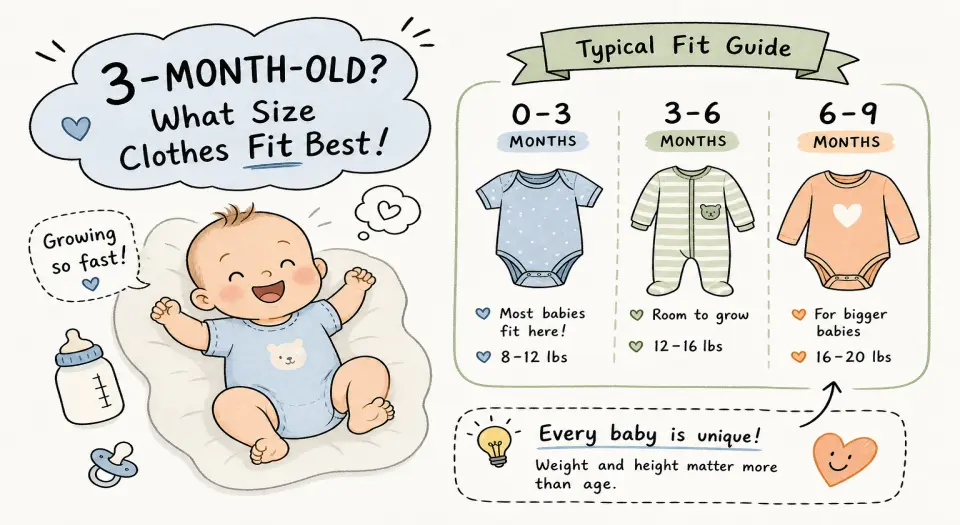
What Size Clothes Does a 3-Month-Old Actually Wear?
June 29, 2026
If you're wondering what size clothes a 3-month-old baby wears, the short answer is: it depends on weight and length, not the number on the tag. You're staring at a rack of baby clothes, or scrolling through an online store at midnight, and the labels aren't helping. "0, 3M." "3M." "3, 6M." Your baby is roughly three months old and you have no idea which one to click. This is one of the most common frustrations new parents run into, and the confusion is completely understandable, baby clothing sizes aren't actually based on age. They're based on weight and length, and the tags rarely make that obvious.
The honest truth is that a label reading "3 months" does not mean "fits your baby at exactly 12 weeks." It means the garment was designed for a baby within a specific weight and length range, and that range can differ from brand to brand. At MaaMio, size charts list ranges by weight and length rather than age alone, which is exactly how sizing should work. Read through this guide and choosing the right size for your baby will start to feel genuinely simple.
What "3 Months" on a Clothing Label Actually Means
Before anything else, it helps to understand that "Newborn" and "3 months" are not just one step apart on a size ladder. Newborn sizing typically fits babies up to about 50, 56 cm and 3, 3.4 kg. The "0, 3M" size picks up from there, covering roughly 53, 61 cm and 2.9, 5.4 kg. By the time most babies are actually three months old, they've already moved well past the Newborn range and are sitting somewhere in the middle or upper end of the 0, 3M window, if not already pushing into 3, 6M.
The "0, 3M" vs "3M" label confusion adds another layer. Brands like Carter's use a single-month marker system, so their "3M" label covers approximately 9, 12.5 lb and 21.5, 24 in (about 4.1, 5.7 kg and 55, 61 cm). Brands like H&M and Zara tend to use range-based labels instead, so their "0, 3M" tag covers a similar window. Carter's "3M" and another brand's "0, 3M" often fit the same baby. If you're comparing across brands, think of it as one size step: Carter's 3M aligns roughly with another brand's 0, 3M, and Carter's 6M aligns with another brand's 3, 6M.
What Size Clothes Does a 3-Month-Old Baby Wear, Size Chart
Here's the core reference most parents are looking for. A baby labeled as fitting "0, 3M" typically weighs between 2.9 and 5.4 kg (7, 12 lb) and measures 53, 61 cm (21, 24 in). The slightly narrower "3M" range, as used by brands like Carter's, starts at about 4.1 kg (9 lb) and goes up to 5.7 kg (12.5 lb), with lengths from 55, 61 cm.
A typical three-month-old usually lands somewhere in that 4.1, 5.7 kg and 55, 61 cm zone. For context, baby growth charts show median weights of roughly 6.4 kg for boys and 5.8 kg for girls at three months, meaning babies at or above the median may already be pressing the upper limit of 0, 3M and sizing into 3, 6M earlier than you'd expect.
Weight matters more than age for fit. A baby born at 4 kg will wear a completely different size at 12 weeks than one born at 2.8 kg. Two babies both described as "three months old" can be separated by an entire size range. This is why checking the weight and length columns on a brand's size chart will always give you a more reliable answer than buying based on the age printed on the tag. For a convenient reference chart many parents find helpful, see the Craft Yarn Council's baby size chart.
For parents reading international charts: European brands often size baby clothes using the baby's height in centimeters. So "size 62" means the garment is designed for a baby approximately 62 cm tall, which puts it squarely in the 0, 3M to 3M equivalent window. For reference: 1 inch equals 2.54 cm, so 62 cm is roughly 24.4 inches. If you need to switch between systems quickly, treating the centimeter number as the baby's height gets you there faster than any conversion formula.
How to Measure Your Baby for the Right Fit
Three measurements give you everything you need to shop with confidence. The first is length: lay your baby flat on a firm surface and measure from the crown of the head to the heel. The second is weight: use a baby scale, or weigh yourself holding your baby and subtract your own weight. The third is chest circumference: wrap a soft tape measure around the widest part of the chest, just under the arms, with the baby relaxed and breathing normally. For a step-by-step walk-through of measuring techniques, see this how to measure baby for clothes guide.
Why Chest Measurement Matters
Chest measurement gets overlooked, but it matters especially for onesies and rompers. A baby can be perfectly average in length but broader in the torso, and if the chest measurement is off, those snap closures at the bottom simply won't close comfortably. The distance from the neckline to the snap closure is one of the quickest indicators of a poor fit when you're holding a garment up and eyeballing it before trying it on.
When Measurements Fall Between Sizes
When your baby's measurements fall between two sizes, the answer is always the same: go up. A garment with a little extra room is wearable; a garment that's too tight restricts movement and causes discomfort. Rolled-up sleeves are fine. A snap that won't close is not. If in doubt, the same weight-first principle applies here: if your baby's weight points to the larger size, trust it over the length measurement.
Size Labels Across Countries: What 62, 3M, and 0, 3M All Refer To
Once you start shopping across different brands or browsing international baby stores online, the size labels can start to look like a different language entirely. European brands, particularly Scandinavian and German labels, use a centimeter-based system where the number on the tag represents the baby's height. Size 56 fits a baby around 56 cm tall (roughly Newborn stage), size 62 fits a baby around 62 cm (the 0, 3M or 3M window), and size 68 fits a baby around 68 cm (the 3, 6M stage). The number is height, not age, and that makes it one of the more intuitive systems once you know what you're looking at.
In Bangladesh, many baby clothing listings through local online shops use US-style age-based labels: 0, 3M, 3, 6M, 6, 9M, and so on. Some listings combine age and weight in the same description. When the label alone doesn't tell you enough, the brand's own size chart is the only reference that matters. MaaMio's size guide maps these labels to weight and length ranges for exactly this reason, so parents shopping locally don't have to reverse-engineer an international sizing standard to figure out what fits their baby today.
When to Move Up from 0, 3M to 3, 6M
Most babies outgrow the 0, 3M range somewhere between two and three months. Fast-growing babies can hit the upper limit as early as six to eight weeks. The physical signs are clear once you know what to look for: snap closures that won't lie flat or pop open on their own, sleeves that end above the wrist, necklines that look snug around the throat, and onesie fabric pulling tight across the belly. Red marks or indentations left on the skin after removing a garment are also a reliable signal that the fit has become too tight.
From a buying strategy perspective, the 0, 3M stage is genuinely short. Many parents find that stocking up heavily on that size isn't worth it. The 3, 6M window lasts considerably longer and gives you far more use per piece. A practical approach is to buy a small number of 0, 3M items and move quickly into 3, 6M, sometimes overlapping sizes for a few weeks during the transition. Think of 0, 3M as the opening chapter, not the whole book.
How to Shop Smart and Avoid Wasted Money
Sizing up by one range is not wasteful. Buying 3, 6M pieces for a baby currently in 0, 3M extends the life of each item by weeks, and clothes with a little room in the torso and length are far more comfortable than ones bought to fit right this moment. Rolled sleeves are a non-issue. A garment the baby has outgrown before you've washed it three times is a frustrating loss. The room-to-grow principle is one of the most practical things any new parent can adopt early.
For parents who want a straightforward starting point, MaaMio's combo sets for the 0, 3M and 3, 6M stages take a lot of the decision fatigue out of this process. These sets are designed to cover both the early and growing stages back-to-back, with sizing built around the weight and length ranges relevant to the local market, so you're not guessing whether an international label translates correctly. A combo set bridging both windows is the most efficient way to cover this stage without overspending. For an easy explainer on how baby clothes sizing typically works across brands, see Care.com's guide to baby clothes sizes.
One practical note: always check the specific brand's chart before adding to cart, especially when shopping from international listings. The same "3M" label can fit slightly differently depending on the cut, the fabric, and whether the brand skews generous or slim. The chart on the product page is a more reliable guide than the label on the tag.
The Label Is a Starting Point, Not a Guarantee
The age printed on a baby clothing tag gives you a rough starting point. What actually determines the right fit is your baby's weight and length, measured against the brand's own chart. Understanding what size clothes a 3-month-old baby wears comes down to knowing that most babies at this stage fall somewhere in the 0, 3M to 3, 6M range, and that the 3, 6M size often delivers better value because it lasts longer through a period of rapid growth.
Three habits make baby clothes shopping feel straightforward every time: measure in length, weight, and chest; read the label in the context of the specific brand's system; and size up rather than buying to fit exactly right now. Once these are part of your process, the endless rows of size labels stop feeling overwhelming.
If you're starting from scratch or restocking for this stage, check MaaMio's size guide for a reference that maps weight and length to real labels, then explore the combo sets designed for exactly the 0, 3M and 3, 6M window. It's the most practical way to get the right fit without buying more than you need.
Frequently Asked Questions
What size does a 3-month-old baby typically wear?
Most 3-month-olds wear 0, 3M or 3M, depending on their weight and length. Babies weighing around 4.1, 5.7 kg and measuring 55, 61 cm generally fit 3M or 0, 3M sizing. Heavier or longer babies may already be in 3, 6M.
Is 0, 3M the same as 3M?
Not exactly, but they often fit the same baby. Brands like Carter's use "3M" to describe a range similar to what other brands label "0, 3M." When comparing across brands, treat them as equivalent and always verify against the weight and length chart.
How long do babies fit in 0, 3M clothes?
Typically between six and twelve weeks, though fast-growing babies can outgrow 0, 3M as early as six to eight weeks. It's a short stage, so avoid stocking up too heavily on this size.
Should I use a baby clothing size converter?
If you're shopping European brands that use centimeter sizing, a simple size converter helps. Size 62 (cm) maps to the 0, 3M or 3M window; size 68 maps to 3, 6M. Most brand size charts include these conversions directly.