

48 hours only! Get 20% off progressive lenses | Use code: GET20


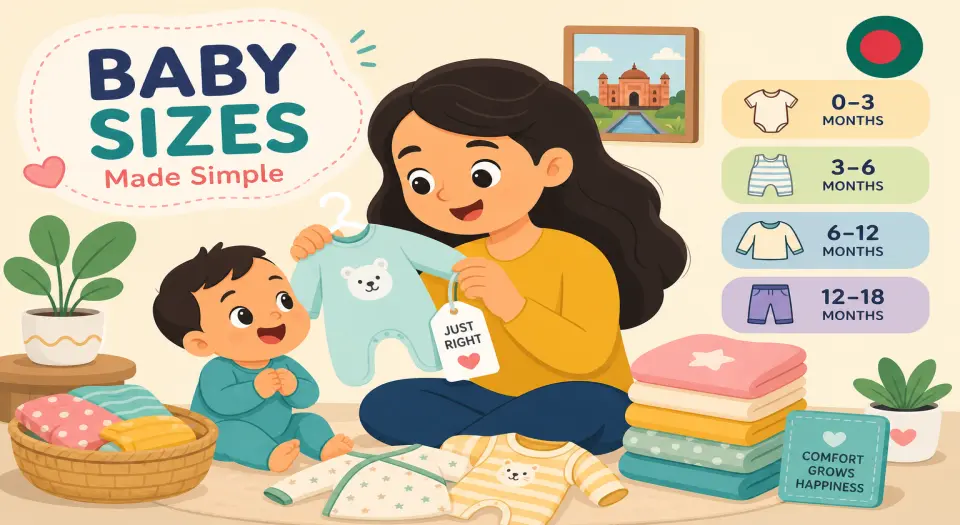
Baby clothing sizes in Bangladesh: a parent's guide
May 31, 2026
You ordered a "3, 6M" romper from an online store. It arrived, looked adorable, and then your three-month-old couldn't get their arms through the sleeves. The label said the right thing. The size seemed correct. And yet, it didn't fit. If this has happened to you, you're not alone, that frustration makes sense. Navigating infant clothing size BD labels is genuinely confusing, and the problem runs deeper than a single mislabeled garment.
The reason it happens is straightforward: infant clothing sizes in Bangladesh don't follow a single universal standard. Age bands, weight ranges, brand-specific cutting, and even the garment type all affect how a label translates to an actual fit. A "3, 6M" at one store might be generous and roomy; at another, it barely clears a standard nappy. Until you know what to look for, every online purchase carries a guess built into it.
This guide removes that guess. You'll learn how to read infant size chart BD labels accurately, measure your baby at home in under five minutes, use a proper size chart for newborn through 24 months, and make smarter decisions whether you're shopping for everyday basics or a gift set. By the end, sizing up for your baby will feel like a system, not a gamble.
Why infant clothing sizes in Bangladesh can feel inconsistent
Age-based vs. weight-based sizing: what's actually on the label
Most Bangladesh retailers print age bands on labels: NB, 0, 3M, 3, 6M, and so on up to 18, 24M. These age bands are a useful starting point, but they assume an "average" baby at each stage. The problem is that newborns especially don't follow averages. A 2.5 kg baby and a 4 kg baby can both be described as "newborns," but they need very different garment sizes. When weight and age point in different directions, weight wins, particularly in the early months.
Some retailers address this by listing both age and weight on the same label, which is genuinely helpful. Others rely on age alone and leave parents to figure out the rest. If your baby is tracking small or large for their age, always cross-reference with the weight ranges for each size band before purchasing.
Why the same "3, 6M" label means different things across brands
There is no national sizing authority in Bangladesh that standardizes infant garment measurements. Each manufacturer sets their own cutting templates, often based on imported fabric patterns or production norms from their supply chain (see the garment industry report for Bangladesh). A local brand manufacturing domestically might cut their 3, 6M bodysuit quite differently from a brand sourcing finished goods from China. Both will print "3, 6M" on the label, but the actual chest and rise measurements can vary by several centimeters.
Garment type adds another layer of variability. A woven cotton frock and a stretch jersey romper might carry the same size label, but the frock has no give and the romper has significant stretch. A label scan alone isn't enough, every purchase needs a quick measurements check against an actual infant clothing size conversion chart.
Infant clothing size BD: the standard size chart (NB, 24M)
Reading the chart: height, chest, and waist explained
The table below gives standard reference measurements for each infant size label, in both centimeters and inches. Height determines the overall garment length. Chest determines how snug the body will be through the torso. Waist matters most for pants, rompers, and any garment with a fitted waistband. Use this as your baseline when a seller doesn't provide their own chart. For another reference, see PatPat's ultimate guide to baby clothes sizes.

How infant clothing size BD maps to weight
For the early size bands, weight is often the more reliable guide. Here are the typical weight ranges to keep in mind: NB fits babies up to about 4 kg; 0, 3M fits roughly 4, 6 kg; 3, 6M covers approximately 6, 8 kg; and 6, 9M fits around 8, 9.5 kg. These ranges can shift slightly by brand, but they give you a solid starting point when you're buying for a newborn.
The clearest rule: if your baby's weight sits at the upper end of a size band, go up a size. A garment that fits perfectly today will be too tight in three weeks, and you'll have gotten far less wear out of it than a slightly roomier size would have given you. Going up a band costs nothing; buying again in a month costs both money and hassle.
How to measure your baby at home
What you need and how to set up
You need a soft measuring tape, a flat firm surface (a changing mat is ideal), and ideally a second pair of hands to keep your baby still. If you're measuring solo, a rolled towel on either side can help prevent rolling. Lay your baby on their back and remove bulky outer layers. Note that a diaper adds bulk through the waist and hip area, so if you're buying a fitted trouser or romper, take your waist measurement with the nappy on for a realistic read. For a clear step-by-step visual guide, see how to measure your baby for clothes.
Taking height, chest, and waist measurements step by step
Work through each measurement in this order so you're not repositioning the baby more than necessary:
- Height: from the top of the head to the heel, with legs flat and relaxed. This is the single most important measurement for overall garment length.
- Chest: around the fullest part of the chest, just under the arms. Keep the tape level all the way around and snug but not compressing the skin.
- Waist: around the natural waist. Slide two fingers inside the tape before reading the measurement so it's not pulled too tight.
Once you have these three numbers, you can match most garment types accurately. For bodysuits and rompers, double-check both height and chest. For trousers and leggings, waist is your anchor. For frocks, chest measurement matters most.
How label styles differ across Bangladesh stores
S/M/L labels vs. month-based labels: what you're actually looking at
Some sellers, especially on larger marketplaces, switch to S/M/L labels once a baby moves past 12 months. On Daraz listings, for example, you'll sometimes see "XL" used to describe a garment suitable for 12, 24 months. These letter labels are almost never consistent across sellers, so treat them as a rough guide only. As a common informal mapping used by some sellers: S tends to sit around 6, 9M, M around 9, 12M, L around 12, 18M, and XL around 18, 24M, but this varies enough across stores that you should always cross-reference with the measurement table above rather than trusting the letter alone.
International brands sold in Bangladesh add another layer of variation. Carter's sizing guidance uses weight and length together, their 6M, for instance, fits babies roughly 5.7, 7.7 kg and 61, 68 cm. H&M Baby and other European brands use height in centimeters as the primary size marker, where the number on the label (like 62 or 74) represents the maximum baby height for that size. Neither maps cleanly to Bangladesh age-band labels, so pull out your baby's measurements before ordering from any international brand.
What to do when a product listing has no measurement details
This is common on marketplace platforms where sellers upload minimal product information. Your first move is to message the seller directly and ask for the garment's actual dimensions in centimeters, not the age label. Ask specifically for chest width, garment length, and waist opening for bottoms and rompers. If the brand has a standalone website, check there for an infant size chart BD before trusting the marketplace listing.
If you can't get actual measurements and the return policy is unclear, treat it as a higher-risk purchase. Factor that uncertainty into your decision, especially if you're buying as a gift or buying ahead of time for an upcoming season.
Fit rules for common baby garments
Bodysuits and rompers: why sizing up usually wins
These garments are inherently snug through the rise and crotch by design. If your baby is in the upper half of a size band, or is longer than average for their age, go one size up. A slightly larger bodysuit is functional; one that pulls at the snaps or constricts the belly is not. The diaper-room rule is simple: a well-fitting bodysuit should close comfortably over a standard nappy without any stretching at the snaps. If you're pressing down hard to close it, the size is already too small.
Cotton-heavy garments also shrink after the first wash, as a general rule of thumb, expect around 3, 5% shrinkage, and potentially more if tumble-dried on high heat. A bodysuit that fits "just right" at purchase can become noticeably tight after one wash cycle. Sizing up by half a band gives you room for both growth and laundering.
Frocks, sleepwear, and seasonal sets: different priorities
Frocks with a fitted chest cut should be sized to your chest measurement first. If the chest fits well, the length can usually be adjusted with the way it's worn. Sleepwear is a case where a looser fit is the safer and more comfortable choice: if your baby is near the top of a size range, move up. A slightly long sleeper is easier to manage than one that restricts movement overnight.
Seasonal combo sets, Eid collections, winter bundles, and similar curated packs, present a specific challenge: you're often buying weeks or months ahead of when the baby will wear them. Size for where your baby will be at the time of wearing, not at the time of purchase. If your baby is currently 4 months old and the Eid set is for three months from now, size for a 6, 7 month old, not a 4 month old.
Shopping for infant clothing online the smart way
What a reliable product listing should include before you buy
A trustworthy listing for infant clothing shows garment measurements in cm (not just an age label), fabric content, and ideally a note on washing shrinkage if the material is cotton-heavy. If a listing shows only a model photo and an age range, that's a red flag. Sellers who know their product provide actual numbers. Sellers who don't know or don't care skip them.
Look for listings that specify chest width, garment length, and neckline opening at a minimum. For bottoms and rompers, waist circumference should also be listed. If you're choosing between two sellers and one provides measurements while the other doesn't, the decision is straightforward.
How MaaMio makes sizing easier for each infant stage
For parents who want to skip the guesswork, MaaMio is a Bangladesh-based store that pairs a clear infant size guide with curated combo sets organized by stage, from newborn through 24 months. Instead of buying individual pieces and hoping they coordinate in both fit and style, their stage-specific bundles are sized consistently across items in the set. That makes MaaMio a practical starting point for first-time parents building out a wardrobe, as well as for gift buyers who want a ready-to-gift newborn set without juggling individual sizing across multiple products.
Simple rules for returns and size exchanges
Before purchasing from any online store, check three things: whether they accept exchanges for sizing issues, what the return window is, and whether the item must be unwashed and untagged. Most Bangladesh online platforms that handle returns well will state this clearly on their product pages or in their FAQ. The standard policy on platforms like Daraz is typically 14 days from delivery, with the item unused, unwashed, and in original packaging with tags attached.
If a store's return policy is vague or missing entirely, factor that uncertainty into your purchase decision. A slightly higher-priced item from a seller with a clear exchange policy is often the better choice than a cheaper item from a seller who goes quiet when the fit doesn't work out.
Getting size right is a skill, not luck
Infant clothing sizes in Bangladesh run on age labels, but those labels are not universal, the same number means different things across different brands and sellers. Measurements always win over trusting a label alone. Before you buy anything, note your baby's height, chest, and waist. Cross-reference against a size chart. Apply garment-specific fit rules, especially for bodysuits, rompers, and anything with a fitted rise.
When shopping online, look for sellers who list actual garment dimensions alongside their age labels. Prioritize stores with a clear exchange or return policy. And when buying seasonal sets or gifts in advance, size for where the baby will be at the time of wearing, not right now. With these habits in place, finding the right infant clothing size BD for your baby stops being trial and error and becomes a straightforward decision every time.